11-a-side football match administration in practice
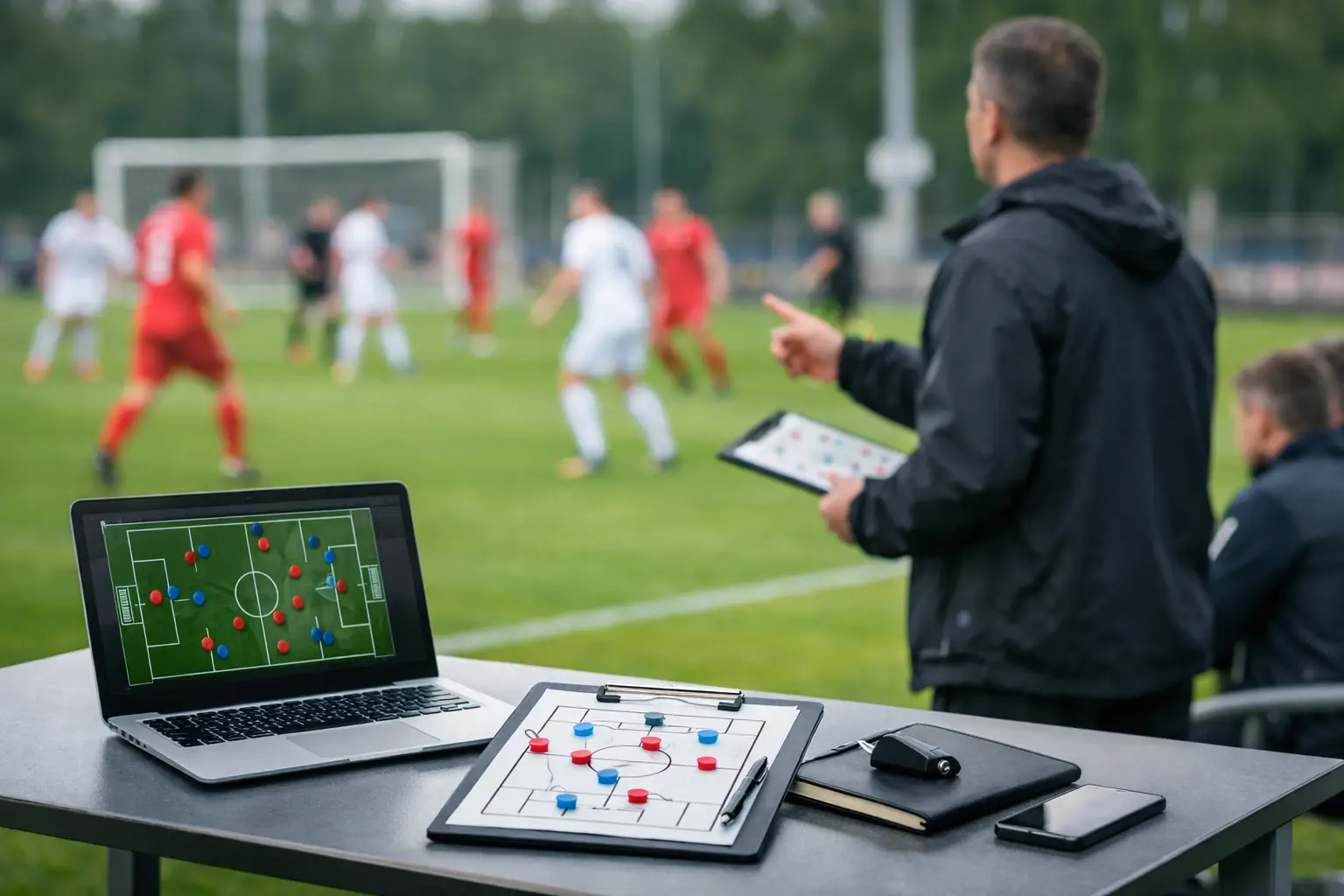
The first mistake often happens before kick-off. The lineup is ready, the bench is restless, and the coach is already juggling three things at once. That is precisely why 11-a-side football match administration should not be something you "handle as you go". In a full-scale match with a larger squad, more substitutions and more to keep track of, good administration becomes part of match leadership itself.
In 11-a-side football, the load on the support staff is higher than many people think. You are not just following the game. You also have to register goals, cards, substitutions, who has been on, who is going on, and how you distribute playing time in a way that is fair and makes sporting sense. When this is handled with loose notes, memory and quick messages on the sideline, mistakes come quickly.
What 11-a-side football match administration actually involves
Match administration in 11-a-side football is about keeping control of the match's operational details while the game is going on. That sounds simple, but in practice there are many small decisions happening close together. A goal often comes right after a substitution. A yellow card has to be registered immediately. A player asks about playing time, while the next stoppage might be the last chance to make a planned change.
The more players you have available, the greater the need for structure. In 11-a-side football, many teams work with larger squads than in smaller formats, and then it is rarely enough to just remember who went off ten minutes ago. If you want a precise overview of playing time, every event has to be captured when it happens.
This is also where the gap between plan and execution becomes clear. Most coaches have an idea of how they want to rotate. But a match takes on a life of its own. Injuries, the run of play, intensity and the result all change the priorities. Then you need a system that gives you a quick status without having to search through notes or ask the person next to you.
Why the 11-a-side format makes greater demands
In 5-a-side and 7-a-side, the distances are smaller, the substitution frequency is often higher, and the overall picture is easier to hold in your head. In 11-a-side, the consequences of poor overview are greater. Playing time is more demanding to balance, the flow of play is more complex, and there are more roles to coordinate.
For a youth coach, this can be about fair distribution and documentation over time. For a senior team, it can be about knowing exactly who is at risk of being overloaded, or who has already been shown a yellow card and needs to be managed smartly for the rest of the match. In both cases, precise match administration is a tool for better decisions, not just tidy paperwork.
There is nonetheless an important distinction here. In some matches, the level of detail is decisive from the first minute. In others, simpler registration is enough. It depends on the level, the squad size and what the team actually needs to learn from the match afterwards. The point is not to register as much as possible. The point is to register what you are going to use.
The common problems on the sideline
The classic setup is familiar to most: a note in your pocket, a notes app that was not made for football, or an assistant trying to keep track of everything while also watching the match. It works until it does not.
The problem is rarely a lack of effort. It is that the tools do not fit the situation. When you are standing on the sideline, you do not have time for more steps than necessary. If it takes too long to register a substitution, it gets postponed. If the information is not visible straight away, it becomes less useful. And if only one person understands the system, a lot falls away when the tempo rises.
This creates three typical mistakes. The first is inaccurate playing time. The second is incomplete registration of match events. The third is weak communication between the head coach, the assistant and the team manager. Small errors on their own, but over a season they become a poor basis for both workload management and sporting assessments.
How 11-a-side football match administration should work in practice
Good match administration has to be fast enough to use live. That is the whole test. If the solution only works when you have calm and time, it does not work well enough for match day.
For 11-a-side football, that means substitutions must be registrable with one tap or two, not through several screens. Goals and cards must be enterable at the very moment they happen. Playing time has to update automatically, or so simply that it does not become an extra job. And the overview has to be clear enough that you can see the status in a few seconds.
This is where a dedicated match-day app delivers more value than general note-taking solutions. You are not working with text. You are working with match events. When the tool is built for football from the sideline, the workflow becomes shorter and more reliable.
For many coaches, the biggest gain is not just that things get registered. It is that they no longer have to spend their attention remembering everything. When the mind is freed from the details, it becomes easier to read the match, follow the players and make the right adjustments along the way.
From chaos to control with a simple workflow
The best workflow starts before the match. If you have the squad entered, the starting lineup ready and the bench defined, you save valuable time once the match is under way. Then registration along the way becomes an extension of the planning, not a separate job you have to start from scratch.
During the match, one person should have main responsibility for the administration, even if several can contribute information. That creates fewer misunderstandings. If the head coach manages the substitutions, the assistant can do the registering. If the coach registers personally, the interface has to be fast enough that it does not come at the expense of the coaching.
After the match, the value of good administration is clear. You have an overview of playing time, events and substitution patterns without reconstructing anything afterwards. That makes evaluation easier, and it gives a better starting point for the next match.
When digital match administration has the greatest effect
It is not the case that every team has to digitise everything at once. But in 11-a-side football, the benefit comes sooner than many think. As soon as you have a squad where several players expect playing time, or when you want tidy documentation across several matches, manual handling becomes cumbersome.
The greatest effect often comes in three situations. When the team has many substitutions to keep track of. When several people in the support staff need the same picture of the match. And when the coach wants to use match data actively afterwards, not just store it for the record.
For clubs and teams that work in a structured way, this is also about trust. Players and parents feel more at ease when playing time and events are handled precisely. It does not mean every decision will be popular, but they become easier to explain when the basis is tidy.
A tool has to match the tempo of the game
Many digital solutions promise a lot but fall down on one point: they are not fast enough where they are actually meant to be used. On the sideline in an 11-a-side match, you have no room for delays, detours or unclear screens. Everything has to be made for action at speed.
That is why a specialised tool can be more useful than a broad club platform. Match administration is a job of its own. It requires focus on a few tasks, carried out very quickly. When the goal is to register substitutions, goals, cards and playing time while the match is live, simplicity is not a bonus. It is the whole point.
MatchDay is built around exactly this need - to give coaches and team management a fast, mobile workflow for match day, without unnecessary steps.
What to look for in a solution for 11-a-side football match administration
The most important thing is not the most features. The most important thing is whether the solution is actually used from the first to the last minute. You should be able to set up the squad quickly, register match events without friction and get a clear overview of who is playing, who has been substituted on, and how playing time is distributed.
It is also worth thinking about who is going to use the solution. An experienced coach and a volunteer team manager often have different digital habits, but both need something that is intuitive. If it requires training every time a new person takes charge on the bench, the system becomes fragile.
Finally comes the question of the level of detail. Some teams only need control of substitutions and playing time. Others also want a full match log with goals and cards. A good solution should support both, without making the simple option cumbersome.
When match day starts, you do not want to spend energy on the administration. You want to spend your energy on the team. That is when a simple system makes the biggest difference - when it lets you stay in control without losing sight of the match.