7-a-side football match management that works
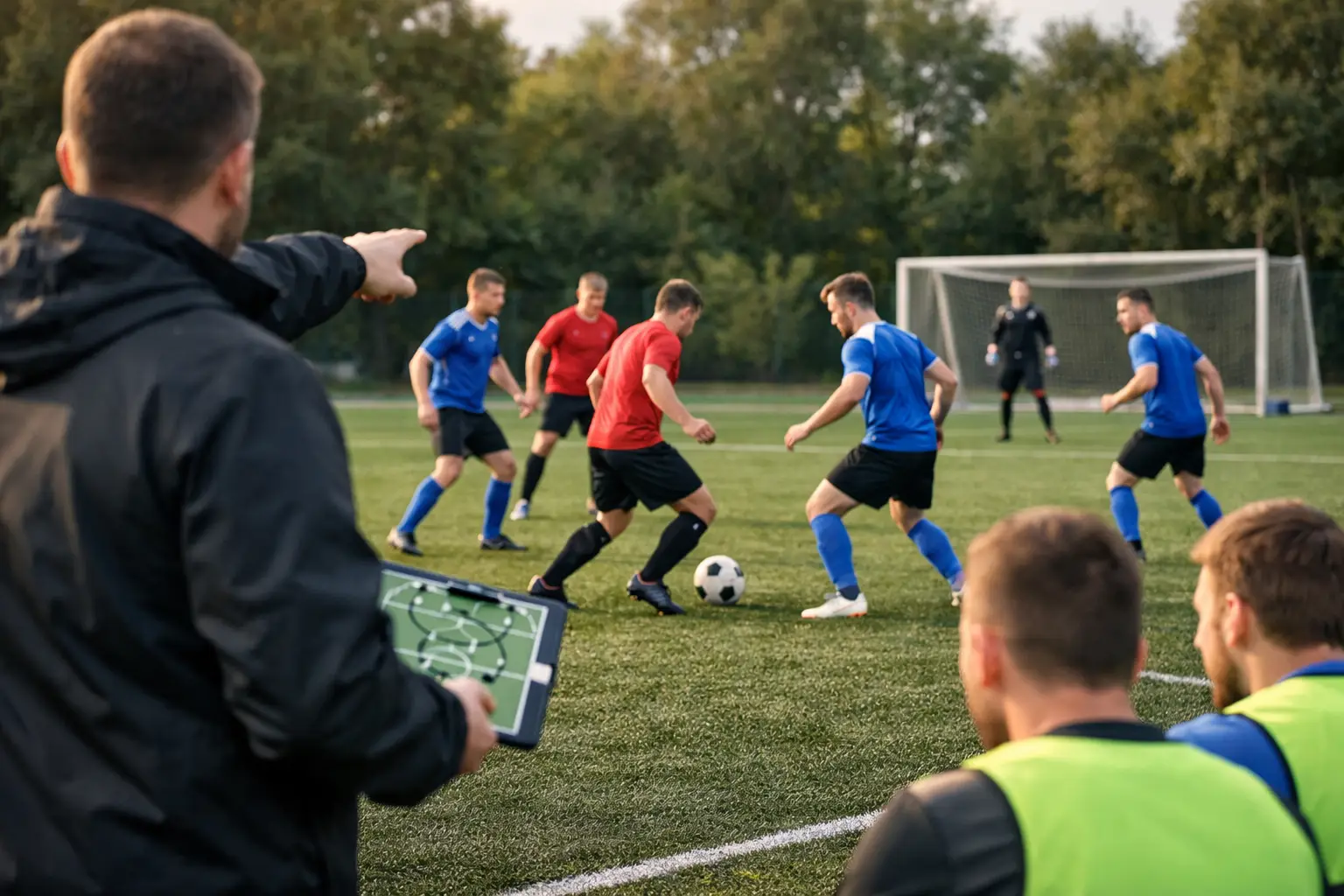
In 7-a-side football the match picture moves quickly. Fewer players means more involvements per person, more transitions and less time to think when you are standing on the sideline. That is why 7-a-side football match management is not just about keeping an eye on the score. It is about having control of substitutions, playing time, roles and events without the actual match coaching grinding to a halt.
Many coaches still try to solve this with a mix of memory, loose sheets of paper and quick messages to a team manager. That can work for short periods, but in 7-a-side the mistakes quickly become visible. A player gets too little time, a substitution is forgotten, or you lose track of who has actually played where. When the match is tight and the tempo is high, it is small margins that decide whether you are controlling the match or just reacting to it.
What good 7-a-side football match management really requires
In 11-a-side matches it can be easier to hide small flaws in the organisation. In 7-a-side it is the opposite. Each player covers more space, there are fewer relationships, and one badly timed substitution can change the whole balance of the team. Match management in this format therefore has to be simple enough to use in real time, but precise enough to give you a basis for decisions while the match is going on.
Above all, you need an overview of three things at the same time. Who is on the pitch right now, how long each player has been on, and which events have actually affected the match picture. That sounds basic, but this is exactly what often slips when a coach also has to guide, motivate and adjust structure between each situation.
On top of that comes fairness. In children's and youth football, playing time is not just a practical question. It is often an expectation from the club, parents and players. If you do not record as you go, it is easy to believe everyone has played evenly when in reality they have not.
Why the sideline quickly becomes chaotic
Most challenges in 7-a-side football match management do not arise because the coach lacks football understanding. They arise because the match administration competes with everything else happening at the same time.
You have to follow the pressing line, see who is drifting out of position, judge when the team needs to settle, and at the same time remember whether the full-back has already had two long spells on the pitch. Add goals, injuries, substitutes waiting to come on and parents asking about the next substitution, and it becomes clear why paper and memory often fall short.
The problem is not just stress. It is friction. Every time it takes too long to note something down, you might just skip it. Every time you have to unlock the phone, open the wrong app or scroll through notes, you take your eyes off the match. Good match management therefore has to be built for one environment - a live match from the sideline.
A practical way to manage a 7-a-side match
The most effective way of working is to reduce the number of things you have to keep in your head. That does not mean less control. It means better control.
Before the match you should have a clear plan for the starting lineup, expected substitution pattern and which players can cover several roles. In 7-a-side flexibility is important, but it works best when it is planned. If you already know which two or three adjustments are most likely, the decisions come faster when the match demands them.
During the match, recording should happen at the very moment the event occurs. Goals, cards, substitutions and playing time lose value if they are entered afterwards and based on guesswork. The less delay, the better the decisions you can make. If a winger has had a tough spell, or a central player has already played longer than planned, you need to be able to see it without reconstructing the match in your head.
After the match you should be left with an accurate match picture. Not for the sake of the archive, but because the next match starts with what you learned in the previous one. Who can handle more minutes? Which substitutions gave better balance? Who was used too little? This is simple data, but in practice it is very useful.
Playing time is more than a fairness question
In 7-a-side, playing time is often treated as a logistics task. In reality it is also a development tool. When you know exactly how much each player has been on, you get a better basis for following up on workload, learning and role training.
For younger teams it is often about equal opportunities and predictability. For older teams it can be more about the match plan, performance and workload management. Both require the numbers to be correct. If you only estimate playing time, conversations with players and parents quickly become weaker. If you have recorded accurately, you stand more confidently behind your assessments.
The same applies to positional use. In 7-a-side, many players are rotated between roles. That can be good for development, but only if you actually know who has played where and for how long. Otherwise it is easy to think you are varying things well, while some players in practice get locked into one role.
Why a simple digital solution brings more calm
The decisive factor is not that the match management is digital. The decisive factor is that it is fast enough to use without disturbing the coaching. A solution that requires too many steps is just another distraction. A solution that lets you record events with a single tap does something else - it removes administrative noise.
For a coach on the sideline this means less typing, less double-checking and less risk of missing match moments. You quickly see who is on, who should be substituted, and which events have already been recorded. That gives you more time for what actually moves the team forward: observation, communication and adjustment.
This is where a tool like MatchDay fits in naturally. Not as a general club tool, but as a pure match-day tool for coaches who need speed and overview where the decisions are made. The point is simple: when the administration goes faster, the coaching gets sharper.
7-a-side football match management in practice on match day
Good match flow starts long before kick-off. If you have the squad ready and the roles defined, the first half becomes easier to manage. If you also have a clear plan for when you want the first substitution window, you avoid making all the judgements on impulse.
But matches rarely follow the plan completely. Some players need a break earlier than expected. Others grow into the match and should stay on longer. That is why match management has to support quick changes without the overview disappearing. This is where many setups collapse. They work as long as everything goes according to script, but not when the match becomes messy.
In 7-a-side it is often enough with one goal or one injury for the whole rhythm to change. Then you need a system that lets you adjust without starting over mentally. If you immediately see playing time and active players, it is far easier to make the right moves.
It is not about more data, but the right data
Some coaches are sceptical about recording during the match because they do not want to make the sideline unnecessarily technical. That is a fair point. No one needs complicated dashboards in the middle of a 7-a-side match.
At the same time, the alternative is often worse. Without a simple way to record core information, you rely on memory in a situation where memory is under pressure. Then it becomes more gut feeling than management. That may be enough in some matches, but over time it gives less precision.
The right data in 7-a-side is quite simple: goals, substitutions, cards, playing time and who is on the pitch. That goes a long way if the recording is fast and the overview is clear. More than that is often unnecessary on match day.
When simplicity actually becomes an advantage
It is easy to think that match management should be advanced to be useful. In practice it is often the opposite. The simpler the system is, the greater the chance that it actually gets used consistently.
This is especially true in grassroots football, where one and the same person is often coach, administrator and match host over the course of the same day. Then you do not need more features. You need fewer obstacles. A tool built for one purpose often has higher value than a platform that tries to do everything.
For 7-a-side coaches this means better flow on the sideline, more reliable substitutions and less uncertainty after the match. You avoid wondering whether everyone got the right amount of playing time, or whether you forgot to note a decisive substitution. That sounds minor, but that kind of reassurance is felt throughout the whole way the match is run.
Good 7-a-side football match management should not steal attention away from the match. It should give you enough order to be present in it, make better choices along the way and approach the next match with fewer questions than you had last time.