Best app for football teams during matches?
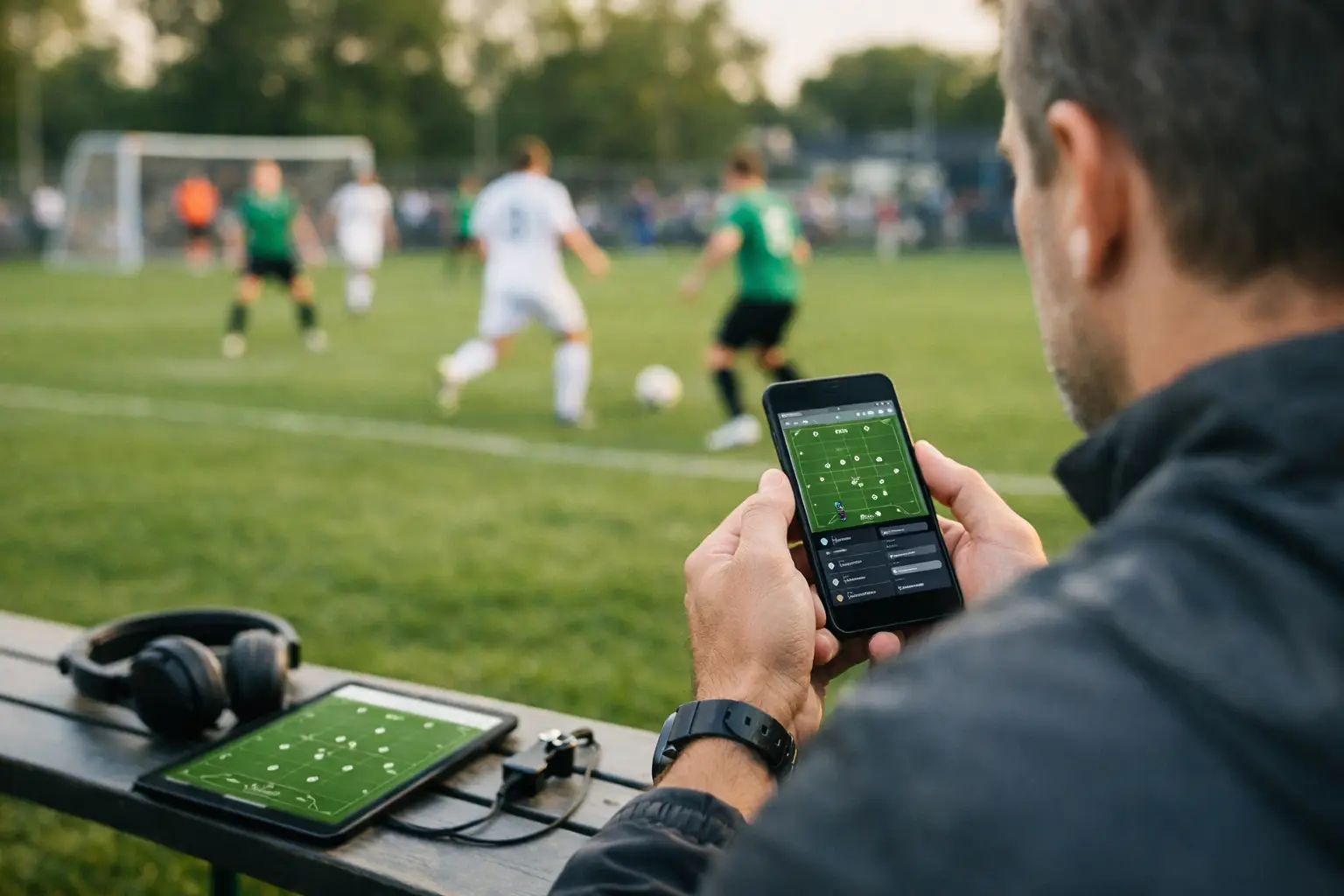
When the match is on, it is rarely the tactics that create the most stress on the bench. It is everything around it. Who came on in the 54th minute? Who is already on a yellow? How many minutes did the left-back actually get? If you are looking for the best app for football teams during matches, it is therefore not enough that the app looks tidy. It has to work quickly, simply and precisely while the play is actually going on.
This is a choice that often gets misjudged. Many coaching teams start out with general note-taking apps, messaging groups or broad club tools that promise a bit of everything. The problem is that live match management is a job all of its own. It happens under time pressure, with interruptions, noise and many small decisions in a short space of time. Then something that works okay is not enough. It has to be built for the sideline.
What characterises the best app for football teams during matches?
The best solution during a match is not necessarily the one with the most features. The best one is the one that lets you log the most important things immediately, without thinking. One tap for a substitution. One tap for a goal. A quick overview of playing time. Clear control over cards and events. When the app becomes simple enough, it actually frees up attention instead of demanding more of you.
This is where match apps differ from ordinary team management tools. Before the match you can spend time planning the squad, formation and logistics. During the match the need is different. Then you need speed, high accuracy and a structure that can withstand you being interrupted in the middle of an entry.
That is also why the user experience matters more than long feature lists. On the sideline, simplicity wins every time. If you have to go through several menus to log a substitution, the app is too slow. If you have to double-check whether an event was actually saved, it creates uncertainty. If you lose track of who is on the pitch, it is not built for matches.
The most common mistakes when choosing an app
The first mistake is choosing an app that is strong on club management but weak during matches. Many systems are good at membership records, training sign-ups and communication, but become cumbersome when you need quick entries along the way. That is not necessarily bad software. It is just built for a different problem.
The second mistake is relying on paper and memory for a bit too long. It can work in some matches, especially with small squads and a low pace. But then comes the match where a lot happens in a short time, and the notes become incomplete. Then you lose both control and documentation.
The third mistake is choosing something that becomes too advanced for the rest of the support staff. An app can have many good features, but if the assistant coach or team manager does not understand the flow straight away, it easily falls out of use. During a match it is an advantage that anyone on the team can take over without a long explanation.
What you should actually look for
Start with the core: logging goals, cards, substitutions and playing time. This is the foundation. If the app does these four things quickly and clearly, you have already solved most of the administrative burden on the bench.
Then you should look at how the app handles different match formats. The needs in 5-a-side football are not quite the same as in 11-a-side football. With fewer players, substitutions tend to be more frequent, and playing time often has to be distributed more actively. In larger formats, control over cards, positions and the run of the match often becomes more important. The best app for football teams during matches should therefore work equally well whether you play children's football, youth football or senior football.
Another important point is how few taps are needed to do a common task. This sounds like a small thing, but it means a lot in practice. Two extra taps seem insignificant at the office. On the sideline, while the ball is out for a throw-in and three players are waiting for word, it is the difference between flow and frustration.
Overview is just as important as speed. You need to see the status at a glance. Who is on now? Who has played a lot? Who should get the next period? Who is on a card? A good match app gives you this information without you having to search.
Why general apps often become a compromise
It is tempting to use tools you already have. Notes on your phone, a spreadsheet, a chat or a broad team app can seem good enough at the start. But these solutions are rarely built for the rhythm of the match. They often require manual follow-up, create duplicate work or make it hard to get a unified picture of the match.
A spreadsheet can be precise, but is slow to use when you are standing out in the wind and weather. A note-taking app is flexible, but gives you no structure for quick events. A messaging group can work for communication, but not for systematic logging. The result is often the same: the coaching team spends more time on admin than necessary, and less time following the match.
That is why specialisation is a strength here, not a limitation. An app that is only built for match management does not need to solve everything. It just has to solve that one job very well.
What makes a match app worth using all season
It is not enough that the app works in one match. It has to be stable enough to become part of the routine. That means the setup before the match has to be simple, the entries during the match have to go quickly, and the data afterwards actually has to be useful.
For many coaching teams, playing time is a big part of this. Especially in youth football and grassroots football, fair distribution is important, but hard to keep control of when the match lives a life of its own. An app that shows playing time on an ongoing basis removes a lot of uncertainty. It makes it easier to make good substitution decisions there and then, and easier to give a clear answer afterwards if someone wonders why the match unfolded the way it did.
The same applies to the event log. When goals, cards and substitutions are gathered together and correctly logged, you get a tidier picture of the match. That is useful both for internal evaluation and for communication with the rest of the team afterwards. Small details become easier to remember when they are actually logged as they happen.
When simple is the best choice
Some coaches think they need advanced analysis to get value from a match app. In reality it is often the opposite. If the goal is better control during the match, simplicity is usually the smartest buy.
A simple app reduces the risk of mistakes. It makes training superfluous or almost superfluous. It fits better in hectic situations, and it gets used more often. That last point is crucial. Even the most impressive solution has little value if it ends up unused after two matches.
Here it is also worth being honest about needs. A team at a high level with dedicated support staff may benefit from more layers of data and analysis. But for most team managers, assistant coaches and head coaches in grassroots and development environments, the need is simpler: control over events, control over playing time and less chaos on the bench.
A practical choice for coaches who work at pace
If you are weighing up what the best app for football teams during matches is, you should think less about everything the app might be able to do, and more about what you have to get done over the course of 90 minutes. Can you log events immediately? Can you see who is on the pitch without stopping? Can you trust the overview when the match gets hectic?
This is where a solution like MatchDay stands out. It is built specifically for match management from the sideline on the iPhone and iPad, and it shows in the way the workflow is thought through. The focus is not on being everything to everyone, but on making substitutions, goals, cards and playing time quick to handle when it actually matters.
That also makes the choice easier. The right app should not feel like yet another system you have to keep up with. It should feel like an extra hand on the bench. When the tool gives you calm, speed and overview, you get more capacity to lead the match instead of documenting it.
So choose the app that takes the fewest seconds away from your eyes on the pitch - because that is usually still where the best match decisions are made.