Football coach app for match day
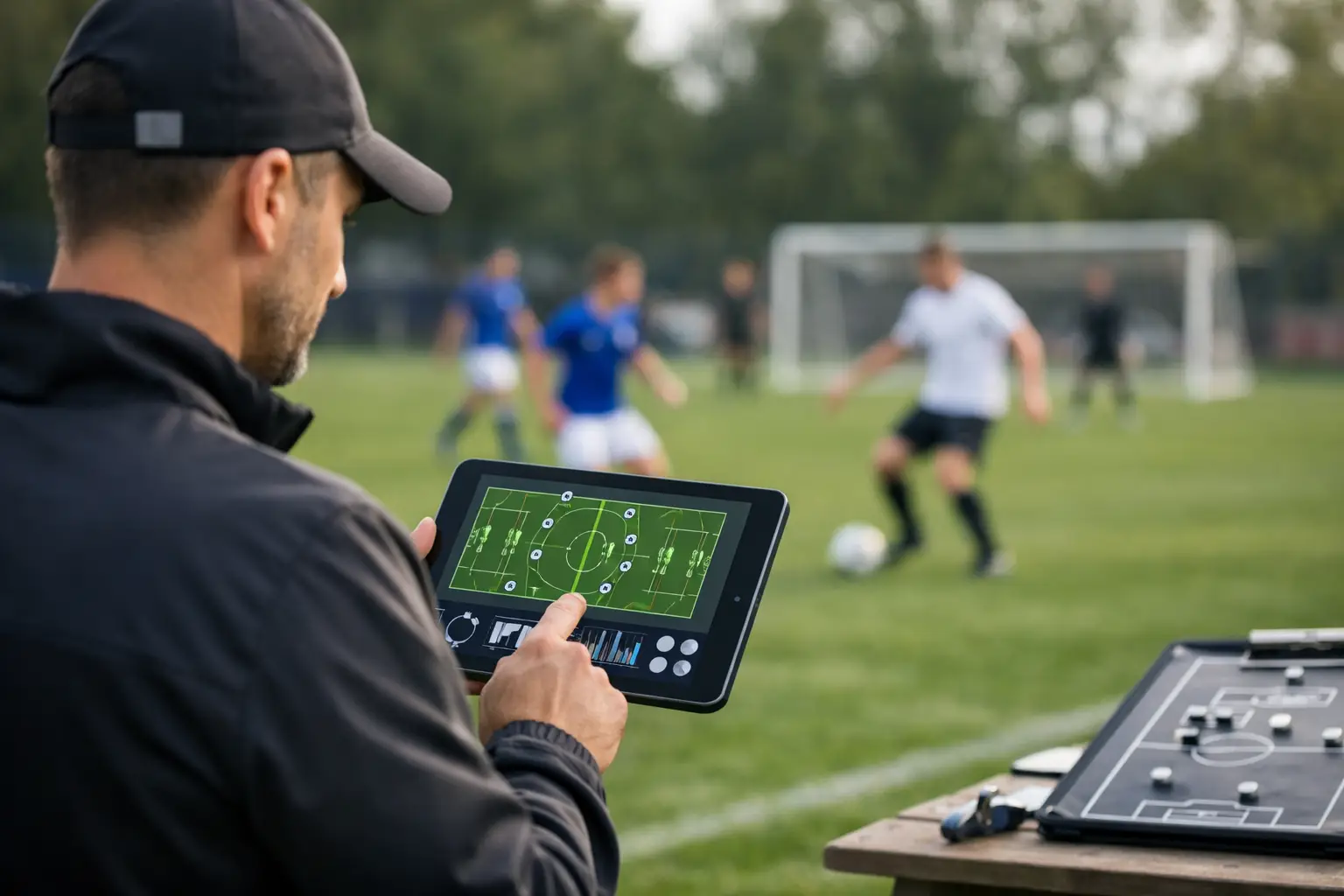
The match kicks off, and within the first five minutes you've already done three things at once - chosen a pressing height, answered a parent on the bench and tried to remember who has actually had playing time. This is exactly where a football coach app makes the difference. Not as an extra layer of administration, but as a tool that removes friction when everything happens at once.
For many coaches, match management is still a mix of paper sheets, quick notes on the phone and pure memory. It works right up until it doesn't. A forgotten substitute, wrong playing time or a lack of overview of cards and goals creates unnecessary uncertainty, especially in close matches where the margins are small. When you're standing on the sideline, you don't need more systems. You need one tool that's fast enough to use while the match is actually going on.
What a football coach app should solve
A good app for football coaches isn't primarily about more features. It's about fewer obstacles. If you have to tap through menus to record a substitution, the app is too slow. If you have to tidy up data after the match, it hasn't solved the most important problem.
The central need on match day is simple: you have to be able to keep control of events, players and playing time without taking your eyes off the match. That means the app has to be built for live use, not as a general club tool adapted to the match afterwards.
This is the difference many people overlook when considering a football coach app. Some solutions are strong on season planning, membership lists and communication. That can be useful in the everyday club setting, but it helps little if you're still jotting substitutions on the back of the team sheet. On the sideline, speed and clarity matter more than breadth.
Why match management often gets messy
It's easy to underestimate how many small decisions are made during a match. Who's coming on next? Who has played the least? Who's on a yellow card? When did that goal actually happen? If you coach children or youth, an extra layer of responsibility comes on top - fair playing time, good flow and clear documentation.
The problem is rarely a lack of effort. The problem is that most ways of working around a match are still manual. Paper is slow to update. Notes apps aren't built for football. Messages between coach and team manager quickly become fragmented. When several people try to keep track of the same match with different methods, the overview disappears.
There's also a pressure element here. At training you have time to pause. In a match you don't. Any tool that demands too much attention competes with the coaching job itself. That's why the best solutions work more as a quick extension of your match eye than as an administrative system.
A football coach app on the sideline has to be fast
When an app is used in the middle of the match, the user experience isn't just a question of design. It's a question of pace. One tap has to be enough to record a goal, card or substitution. Playing time has to update without you keeping a manual log. The layout has to be easy to understand at a quick glance, even when you're standing in rain, noise and interruptions.
It sounds basic, but many solutions miss precisely here. They're made for screen time in calm surroundings, not for seconds on the sideline. A coach doesn't need a pretty system that demands concentration. A coach needs a functional system that can handle interruptions.
That's also why the mobile format matters. A football coach app that works well on iPhone or iPad suits the actual working situation better than solutions that in practice require a laptop or post-match work. Match administration has to happen where the match is.
Which features actually matter
It's easy to be drawn to long feature lists, but on match day there are a few things that really count. You have to be able to record goals, cards and substitutions quickly. You have to see who's on the pitch. You have to keep control of playing time. And you have to be able to handle different match formats without building new systems every time.
For a coach in 7-a-side football, the need is different from 11-a-side football, but the principle is the same. The overview has to be immediate. If you coach younger teams, playing time and rotation often become just as important as the result. If you coach older teams, match flow, discipline and documentation of events become more important. A good app should handle both without becoming heavy.
This is where a specialised match tool has an advantage. When the app is built around actual match events, every tap becomes relevant. You avoid navigating around features you don't need right then and there.
When paper is still used - and why it costs more than you think
Many coaches stick with paper because it feels simple. It requires no login, no training and no battery percentage. That's understandable. But paper has a hidden cost in the form of mistakes, duplicated work and a lack of overview.
The notes often end up incomplete. Timestamps are missing. Substitutes are recorded late or not at all. After the match, someone has to tidy up what should have been easy to log along the way. It's not just impractical. It also makes the evaluation weaker, because the basis becomes less precise.
A digital solution doesn't replace the coach's judgement. It just removes the need to remember everything at once. That brings more calm in the small moments that otherwise create stress.
How to choose the right football coach app
The right choice depends less on level and more on your working situation. If your main need is season administration, a membership register and mailouts, you probably need a broader club tool. If the need is match management from the sideline, you should choose an app built for exactly that.
Look at how quickly you can record an event. See whether playing time updates clearly. See whether the app works just as well in 5-a-side, 7-a-side and 11-a-side. And see whether the interface helps you make decisions faster, not just store information.
It's also wise to think about who is actually going to use the solution. A volunteer team manager and an experienced head coach don't always have the same technical habits, but both need a system that's easy to understand straight away. If the app requires too much explanation, it will often fall away when the matches get hectic.
A more precise picture of the match gives better choices
Good match administration isn't just about order. It influences the choices you make. When you know exactly who has played, substitutions become fairer and more deliberate. When events are recorded as they happen, it becomes easier to evaluate the course of the match afterwards. When you avoid spending mental capacity remembering details, you get more room to read the game.
This is especially useful in matches that swing quickly. Under pressure, small mistakes become more common. Then it's an advantage to have one place that keeps order on the practical side, so you can spend your attention on the players and the match.
For coaching teams and support staff it also gives a better shared understanding. When everyone relates to the same picture of the match, communication becomes easier. It reduces misunderstandings and makes match day tidier.
A solution that fits the reality on the sideline
There are many sports apps, but far fewer that are actually built around what happens between kick-off and the final whistle. That's precisely why a focused solution often works best. When the aim is to make match administration simple in real time, you don't need an all-in-one system. You need a sideline tool that does the most important tasks quickly and correctly.
That's also why a solution like MatchDay meets a concrete need for many coaches. Not because it tries to do everything, but because it's made for the most time-sensitive moment in the coaching role - the match itself.
The best football coach app isn't necessarily the one with the most menus. It's the one you actually use throughout the whole match, without losing flow. If the tool gives you calm, overview and faster control when the pace is high, it has already done its job. And that's often enough to make match day noticeably easier.