How to keep a live match report without chaos
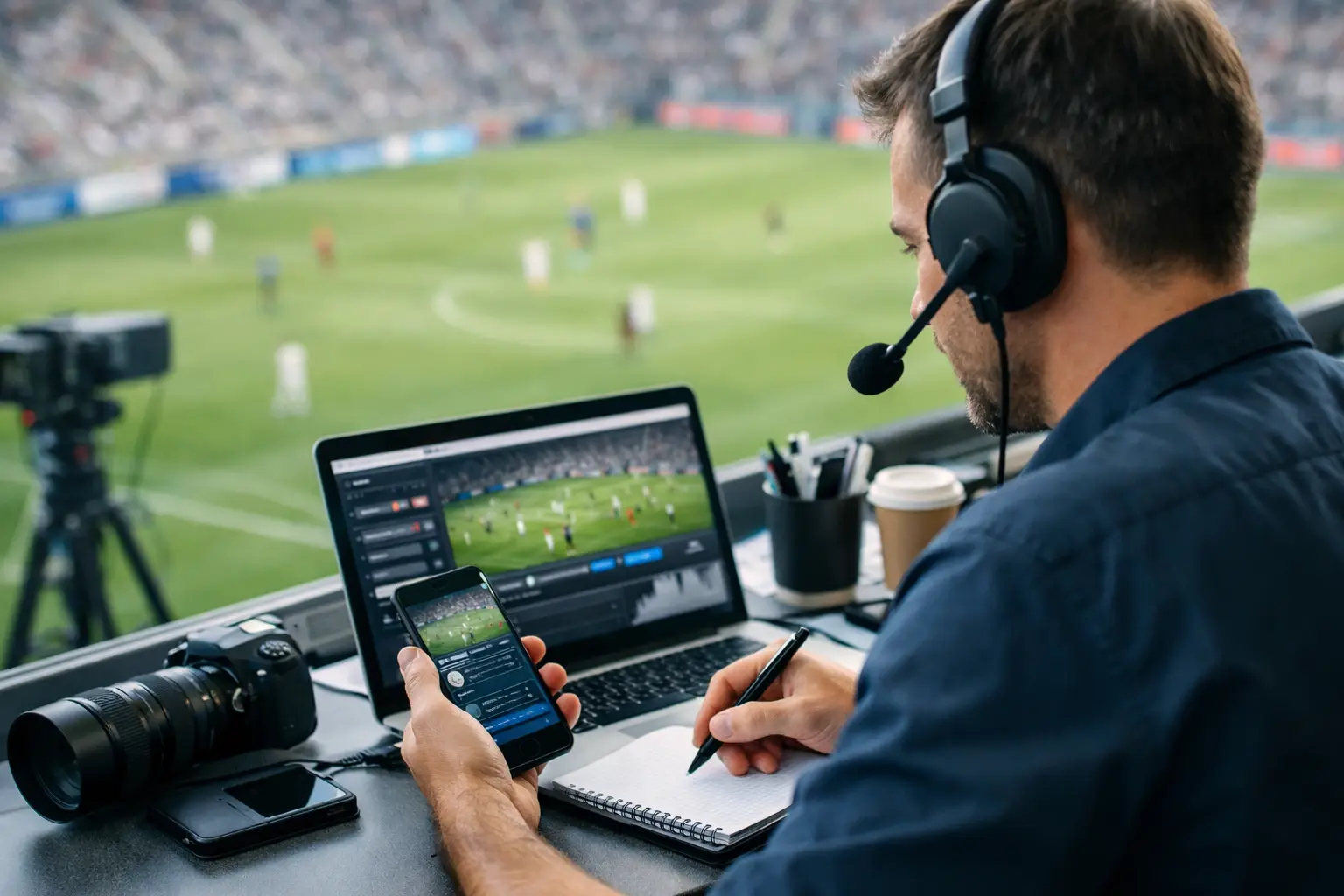
Once the match is under way, you rarely have time to look for a pen, interpret your own notes or try to remember whether the substitution came before or after the goal. If you are wondering how to keep a live match report, it really comes down to one thing: making the recording so simple that it does not steal attention away from the match.
For coaches, team managers and support staff, a live match report is not administration after the fact. It is part of managing the match there and then. When goals, cards, substitutes and playing time are recorded in the moment, you get better control as you go and a more precise picture of the match afterwards.
Why a live match report is more than just documentation
Many people think of a match report as something you finish writing after the final whistle. That works up to a point, but in practice details get lost. Timings slip. Cards and substitutions get mixed up. And if several people try to remember the same situation differently, you end up with a report that is well meant but weak as a working tool.
Recording live gives a different kind of value. You get a running log of events as they happen. That helps not only for reporting, but also for decisions during the match. Has a player already been on for a long time? Who has a yellow? When did the last substitution come? Who has actually had enough minutes? Questions like these come up all the time on the sideline.
This is where the difference between paper and a dedicated match flow becomes clear. Paper can work, but it demands more attention, more interpretation and more tidying up later. In a match, it is speed that decides whether you actually record anything correctly.
How to keep a live match report in practice
The best method is the one you manage to use consistently while the match is going on. That means the setup has to be simple before kick-off, and the recording has to require as little as possible along the way.
Start with your squad ready. Players, starting lineup and any reserves should be entered in advance. If you do this five minutes before kick-off while parents are asking about lifts and the referee is waiting, the chance of mistakes goes up. The preparation is not glamorous, but it makes the actual match record-keeping much easier.
Then you have to decide what should actually be recorded live. For most teams it is enough to focus on goals, assists if relevant, cards, substitutions and playing time. Some will also note period scores or match notes. The point is to prioritise what adds value later. If you try to record everything, you lose the flow.
During the match, one person should have the main responsibility. It can be a coach, an assistant or a team manager, but the responsibility has to be clear. When everyone assumes someone else is keeping track, important events often get recorded too late or not at all. One person in charge gives better rhythm and fewer misunderstandings.
Getting the recording down to one tap
A live match report works best when every action is quick. If you have to open several menus to enter a goal or spend too long finding the right player, you fall behind. Then you start relying on memory again, and the whole point disappears.
That is why a mobile workflow is so effective on the sideline. You do not need to shift your focus for long. You see the event, record it straight away, and are back in the match. For a coach that is crucial. The tool should support match management, not create a new task that pulls you out of the moment.
A good system also gives a clear overview while you record. You should be able to read the match picture quickly, not just collect data. If you have to dig to find who is on the pitch, or how many minutes a player has had, you spend unnecessary capacity in a situation where the pace is already high.
The most common mistakes when keeping a live match report
The biggest mistake is to wait. Many people think they will note the event in a moment, when play calms down. The problem is that the next situation arrives before you get to it. After ten minutes you often have two substitutions, a goal and a card to reconstruct in your head.
The second most common mistake is to record too much. It can be tempting to note everything from pressing height to the mood on the bench, but a live match report should above all cover events that need to be correct. Tactical observations you can jot down in short notes if there is capacity, but they must not disturb the core.
A third mistake is using a tool that is not made for the match. Ordinary note-taking apps can be fine for free text, but they are rarely quick enough for event-driven recording. Match administration requires structure. Goals, substitutions and cards have to be enterable without friction.
Finally, we often see that playing time gets overlooked. For grassroots football, youth teams and development settings this is often just as important as the result. If you do not follow it live, it quickly turns into inaccurate estimates afterwards. That creates uncertainty both within the team and in communication with players and parents.
When paper can still work - and when it does not
Paper is familiar, simple and needs no charging. For some teams and simple matches it can still be enough, especially if one person has a good routine and the match picture is calm. There is nothing wrong with using a solution that actually works for you.
But paper has clear limits the moment the pace picks up. In matches with many substitutions, different playing periods or a need for precise playing time, it quickly becomes cumbersome. You have to write, interpret, tally up and often tidy up afterwards. It takes time, and it makes the report more vulnerable to small mistakes with big consequences.
That is exactly why many people switch to a simpler digital solution. Not because it looks more professional, but because it is quicker to use when the pressure is greatest.
How to keep a live match report without taking your eyes off the game
This is the crux for most coaches. You want control, but you cannot end up with your head buried in a screen. That is why the match report has to be built around short actions and a clear overview.
The best rhythm is simple: prepare before the match, record the event straight away, and use the breaks to check that everything is right. You do not need to analyse everything while the ball is in play. You just need to make sure the foundation is correct. Then you have something to work with at half-time and after the final whistle.
If there are two of you in the support staff, it can also be smart to split the roles. One follows match management and coaching most closely, while the other takes the main responsibility for recording. But for many teams the reality is that one person has to do both. Then simplicity is not a bonus, but a prerequisite.
This is where MatchDay fits well, because the solution is made specifically for this moment on the sideline. Not for general club admin, and not for loose notes, but for quick match recording when you need an overview straight away.
What a good live match report should actually give you afterwards
A good match report should not just be correct. It should be useful. After the match you should be able to see the sequence of events clearly, know who played, how long they played, and which key situations shaped the match.
For youth teams that can mean better follow-up on playing time and workload. For senior teams it may be more about match flow, discipline and substitution patterns. For team managers and volunteers it can quite simply be the reassurance of knowing the reporting is done and the details are right.
There is no single perfect way to work for everyone. A coach in 7-a-side football has different needs from support staff around an 11-a-side team with several substitutes and higher demands for documentation. But the principle is the same: the easier it is to record correctly in the moment, the more value you get both during and after the match.
If the goal is less chaos on the sideline, a live match report is one of the most practical steps you can take. Not because it makes football simpler, but because it removes unnecessary noise when you already have enough to handle.