Football match administration without the stress
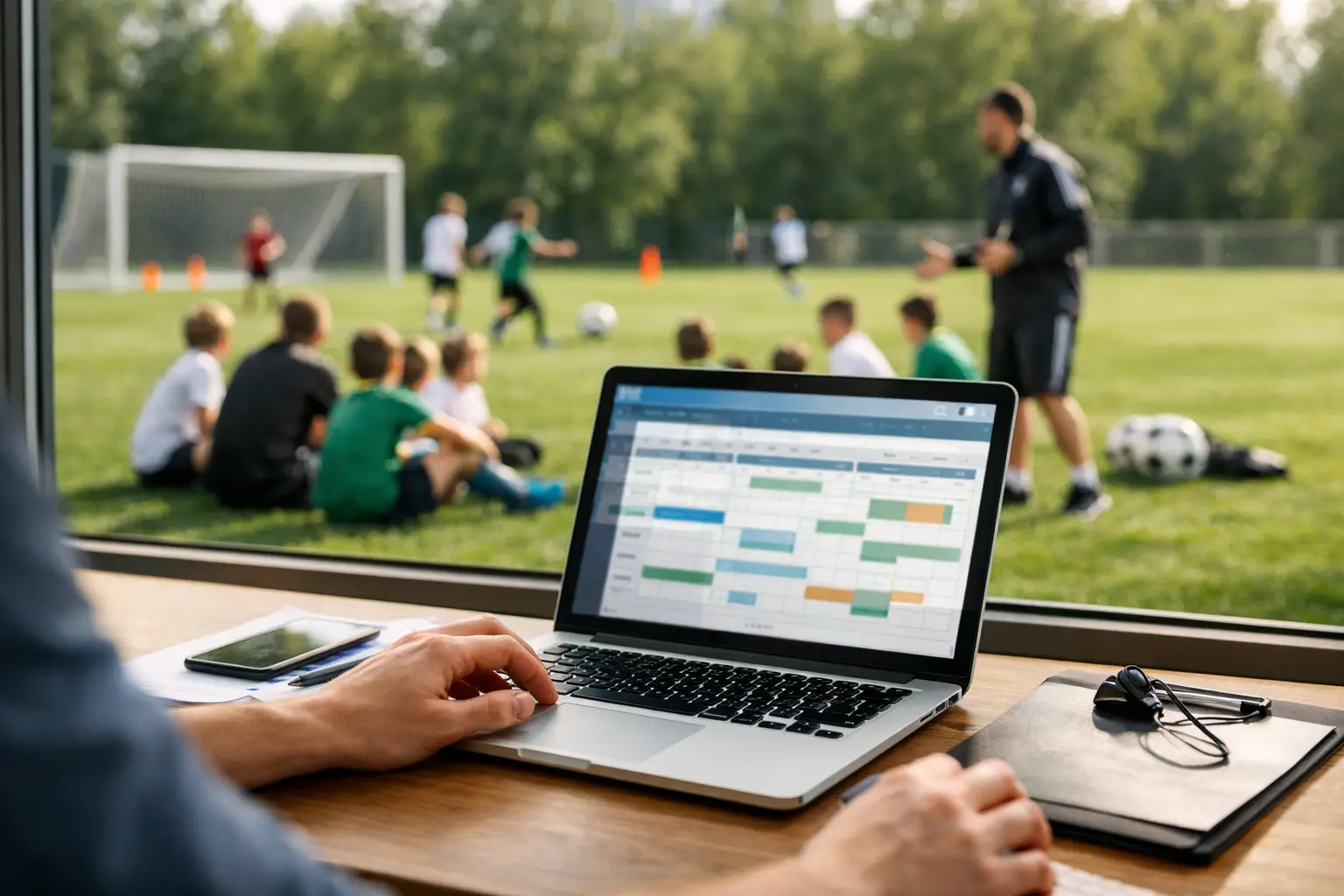
You often notice it before kick-off. The lineup has to be confirmed, playing time has to be shared out, and you know there will be goals, substitutions and maybe a card or two before the match is over. When all of this has to be held in your head at the same time, football match administration quickly becomes a source of unnecessary stress - especially for coaches and team managers who are already making plenty of decisions along the way.
Good match administration is not about extra paperwork. It is about having enough control to be able to follow the match properly. When recording events goes quickly, it becomes easier to keep track of who is on the pitch, who has played how long, and what actually happened once the match is over. That leads to better decisions there and then, and less tidying up afterwards.
What football match administration actually involves
For many teams, match administration starts as a mix of memory, phone notes and a slip of paper in a jacket pocket. It works until the pace picks up. Then small mistakes become common. A substitution does not get noted. A goal gets recorded against the wrong player. Playing time has to be reconstructed after the match, and no one is quite sure what is right.
In practice, football match administration consists of a few but important tasks. You have to be able to record goals, cards and substitutions quickly. You have to know who is on the pitch at any given time. And you have to be able to follow playing time without losing focus on what is happening in front of you. It sounds simple, but from the sideline it rarely is.
The challenge is not just the amount of information. It is the timing. Events happen at the same time. A player wants a word, the referee wants control, and you might also be trying to adjust the formation. The tool then has to be quick enough that the administration does not get in the way of coaching.
Why the sideline needs a different solution
Ordinary note-taking apps and general administration tools are rarely built for match situations. They can store information, but they do not necessarily help when you have to record a substitution in a few seconds. There is a big difference between documenting after a match and steering the match while it is going on.
This is where many coaching teams lose time. Not because they lack the skill, but because they use solutions that require too many taps, too much scrolling or too much manual follow-up work. On the sideline, simplicity is not a bonus. It is a requirement.
A good setup for football match administration therefore has to be made for live use. You should be able to open the match, see the players, record events with one or a few taps and go straight back to the match. If you have to stop and think about the tool, it is already too slow.
The most important things to control during the match
Playing time is often what causes the most frustration afterwards. In grassroots football and age-group teams, fair distribution matters, but it is also easy to lose track when the substitutions come thick and fast. If you do not record on and off in the moment, the numbers quickly become uncertain. Then the conversation with players and parents also gets harder.
Substitutions are the next key point. In matches with many substitutes, especially in 7-a-side and 9-a-side, a lot happens in a short time. You need a system that shows who is on the pitch now, not just who started. That gives better control both on the sporting and the administrative side.
Goals and cards seem simpler, but precision matters here too. Incorrect recording affects the match picture you carry forward. If you later want to evaluate the match, plan the next selection or report internally, you need data that actually adds up.
How good match administration should work in practice
The best solution is usually the one you barely notice. You set up the squad before the match, choose the starting eleven or the lineup, and have the players ready on the screen when the match starts. From there it should be quick to record events without building up a new administrative job along the way.
When a player scores, it should be easy to record the goal against the right person. When a card is shown, it should be loggable straight away. When you make a substitution, the system has to update who is on and off without you having to tidy up later. It is this flow that decides whether a tool actually helps you from the sideline.
For many coaching teams, a phone or tablet is the most practical solution. It is always with you, easily to hand and suits match day better than paper. But mobile match administration only works if the interface is made for quick choices. Small menus and heavy workflows only create new friction.
Football match administration for different formats
The need is not quite the same in every format. In 5-a-side and 7-a-side the substitution frequency is often high, which makes simple recording extra important. In 9-a-side and 11-a-side the overview of playing time and match events often becomes more detailed, especially when the staff use the match actively for evaluation.
That means one tool has to be able to handle different ways of working. Some need above all control over playing time. Others want a clear overview of goals, cards and substitutions. For a coaching team working across age groups, it is a clear advantage if the same solution works from small-sided games to full 11-a-side.
It is also worth being realistic. The younger the players, the less value there is in complicated analysis features during the match. Then simple match administration is often what has the most effect. In older teams the level of detail can be higher, but the recording still has to be quick. No coach gets more out of the match by using the sideline as an office desk.
What you gain by digitising match day
The biggest gain is calm. When events are recorded continuously and correctly, you avoid spending energy on remembering details. That gives better focus on coaching, communication and match management.
The next gain is the quality of the decisions. If you know at all times who has played a lot, who has just come on, and how the match has actually developed, it becomes easier to make the right moves. That applies both in tight matches and in development settings where workload and playing time have to be managed deliberately.
Finally comes the follow-up work. When the match is over, it is a big advantage to have tidy data instead of loose notes. You can evaluate faster, communicate more clearly and move on to the next match without spending time reconstructing the course of events.
When simple beats advanced
There are many digital tools in football, but not all of them solve a concrete sideline problem. Some try to be everything at once - club administration, analysis platform, messaging system and match tool in a single solution. That can work for some settings, but it also often means more complexity.
For coaches who need control precisely while the match is going on, it is often smarter to have a tool that does one job very well. Quick recording of goals, cards, substitutions and playing time gives more value on match day than features you never get round to using once the whistle has gone.
That is exactly why a solution like MatchDay works well in practice. It is made for match administration from the sideline, not as an add-on to something else. For coaching teams who want speed, overview and as little friction as possible, it is a more useful starting point than broad systems with too many layers.
How to choose the right setup
If you want to improve your match administration, you do not need to start with a big process. Start by looking at where the mistakes happen today. Is it substitutions that slip through, playing time that becomes uncertain, or match events that get recorded too late? Then you also know what the solution has to be good at.
Next you should consider how easy the system is to use while the match is actually being played. Not just whether it has many features. A good question is this: can an assistant or team manager start using it without a long explanation, and can the head coach still follow the match without being dragged down into the administration? If the answer is yes, you are close to something that works.
Good football match administration should give more control, not more work. When recording match events goes quickly, the sideline gets calmer, the decisions clearer and the follow-up work simpler. It is often small measures that make the biggest difference - especially when the match is live and everything has to happen right away.