Match history football app for coaches
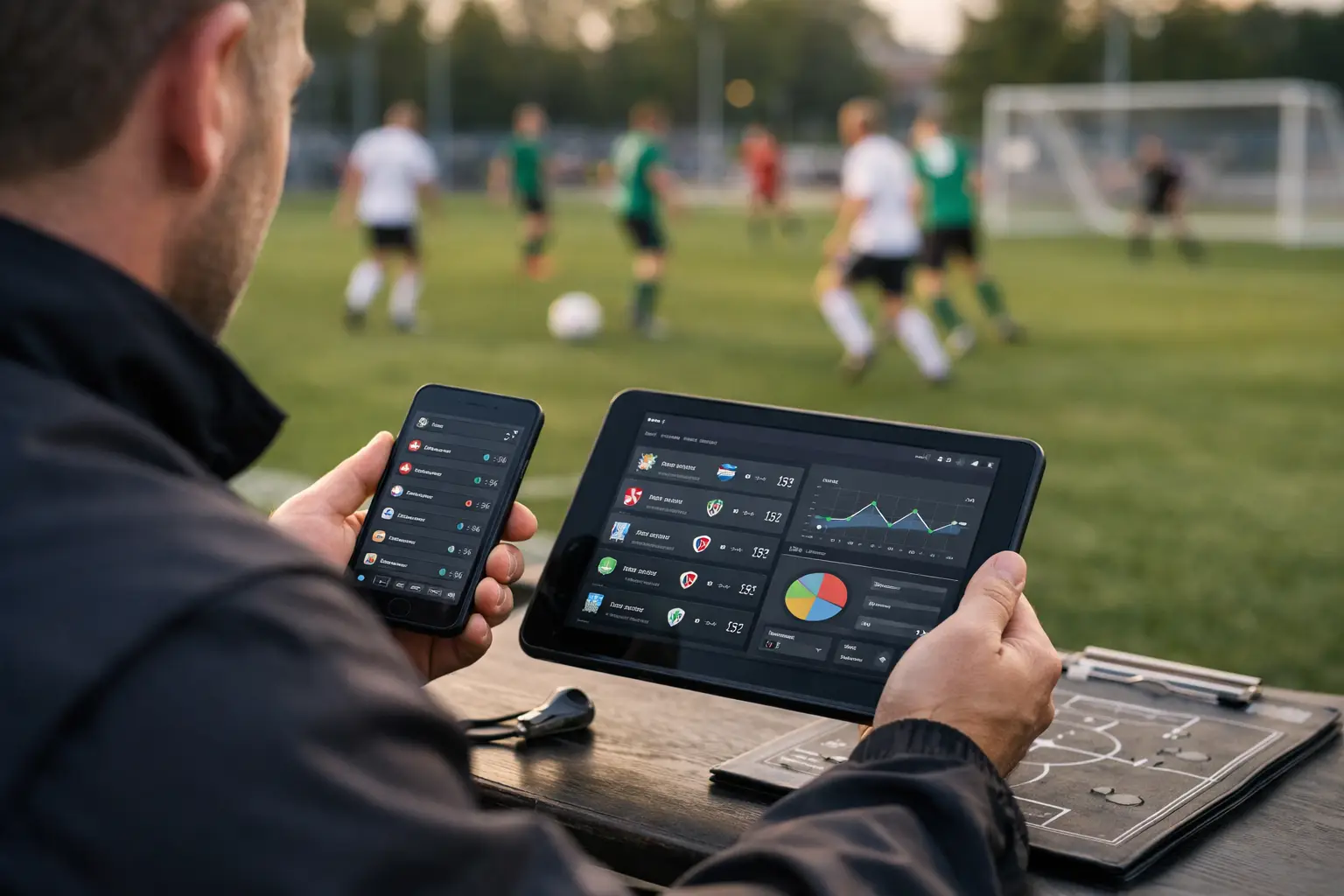
You know the situation. The match is tight, two substitutions happen in quick succession, a player picks up a yellow card, and someone on the bench asks how many minutes they have played. Loose notes or memory rarely cut it then. A match history football app gives you one place for everything that actually happens in the match - and makes it possible to use that information while the match is still going on.
For coaches and team managers this is not about collecting data for its own sake. It is about control. When the flow of the match is recorded as it happens, it becomes easier to make good decisions, follow up on playing time and keep a tidy history after the match. That is especially useful in grassroots football, academies and amateur settings where a lot of responsibility often sits with just a few people along the sideline.
What a match history football app should actually solve
Many people first think of history as something you look at after the match. In practice the value starts long before the final whistle. If the app is built for match day, it should make recording fast enough to work while the match is alive. One tap for a goal. One tap for a card. A simple way to record substitutions and keep track of who is on the pitch.
That sounds basic, but this is where good and poor solutions part ways. A general note app or a spreadsheet can store information, but they are not made for the pace of a football match. On the sideline you need a setup that follows the flow of the match, not a system that asks you to stop and type.
The most important test is simple: can you record events without taking your eyes off the match? If the answer is no, the history quickly becomes incomplete. And an incomplete history creates new problems instead of solving the old ones.
Why match history means more than just follow-up work
Good match recording of course helps you afterwards. You can go back and see when the goals came, which players were brought on, and how the playing time was distributed. But for most coaches the biggest gain lies in the operational side.
When you have a running overview, you do not have to guess. You know who has picked up a card. You know how many substitutions have been made. You know who has had enough playing time and who should come back on. That brings calm to situations where things often get needlessly stressful.
For youth teams and grassroots football this is especially relevant. Many want fair playing time, but in practice it often becomes hard to track precisely when the match gets hectic. With an app that records this as you go, fairness becomes easier to deliver - not just something you hope you managed.
Match history football app in a live match
It is easy to overestimate how much you can note down manually. Before the match many think paper or a quick note to yourself will do. After ten minutes reality looks different. The ball is out of play, someone asks about a substitution, the opponent scores, and suddenly you are missing two events in the log.
That is why a match history football app has to be built for quick actions. That means simple navigation, clear buttons and as little friction as possible. If you have to dig into several menus to record a goal, the solution is too slow. If you need both hands and full attention to log substitutions, it is a poor fit for the sideline.
It is also an advantage when the app works across match formats. The needs in 5-a-side, 7-a-side, 9-a-side and 11-a-side are different, but the need for control is the same. A coach working with several teams or age groups does not need several systems. One setup that adapts to the match format is often the most practical.
What to look for in an app for match history
The most important thing is not how many features the app promises. The most important thing is whether the features you actually need are quick to use. For match administration one simple principle applies: fewer steps give better flow.
Start with the core tasks. You should be able to record goals, cards, substitutions and playing time without detours. It should be easy to see the match status the moment you open the screen. When one player goes off and another comes on, this has to be logged without any doubt about who is on the pitch afterwards.
Then comes the overview. A good history is not just a list of events. It has to be readable. You should quickly be able to see the order of events in the match and pull up what you need without searching. If everything looks technical or cluttered, the information becomes less useful when you need it most.
Finally you should think about who actually uses the app. For some it is the head coach. For others it is the assistant, the team manager or a volunteer. The simpler the system is to understand, the easier it is to use consistently through a whole season.
The practical gain after the match
When the final whistle goes, the part many underestimate often begins. Players and parents ask about playing time. The coaching team wants to remember key events. The next match has to be planned. If the flow of the match is already recorded, you do not have to reconstruct everything from memory.
That gives a better basis for evaluation. Not because you need advanced analysis in every match, but because accurate data makes conversations easier. You see what actually happened, instead of relying on fragmented impressions. That is useful both when you give feedback and when you plan workload and rotation.
The history also becomes valuable over time. After several matches you see patterns. Who gets a steady share of minutes? When do you make the most substitutions? How often do the cards come in particular phases of the match? Insights like these do not need to be complicated to be useful. Often it is enough that the information exists and is easy to access.
When simplicity matters more than advanced features
It can be tempting to choose a solution that does everything. But in match administration more is not always better. If extra features make the core slower, you lose the most important part. For most coaches an app that solves four tasks very well beats a platform that promises twenty things and does them all halfway.
This applies especially on phones and tablets. The screen is smaller, time is short, and the focus has to be on the match. A tidy setup with a clear match flow usually beats a heavy solution with lots of options. Good usability is not decoration here - it is the actual product value.
That is precisely why a specialised match-day app stands out. When the tool is made for the sideline, the features are adapted to the reality coaches face. One tap matters. A clear display matters. Quick access to the history matters. That is where time is saved and mistakes are reduced.
Who benefits most from this?
The need is greatest for those who have to keep order while the match is going on. That of course includes coaches, but also assistant coaches, team managers and others in the support staff. In many settings it is precisely these roles that carry the responsibility for making the match run smoothly.
For children's and youth football the value is often tied to structure and fairness. For amateur and senior teams it is usually more about precise match management and documentation. In both cases the point is the same: less chaos, better overview.
If you already have a system that works perfectly on paper, the need may feel smaller. But that depends on how easy the system is to use under pressure, and how simple it is to pull up the information later. Many find that what seemed fine in one match becomes needlessly cumbersome over a long season.
A better working tool on the sideline
A match history football app should not feel like extra work. It should remove work. When recording events is fast and the overview is clear, you get more capacity for what you are actually meant to do - lead the team.
For coaches who want control over goals, cards, substitutions and playing time in real time, this is what counts. Not big promises, but a tool that works when the match is on. MatchDay is built around exactly that task: making match administration simple, fast and usable from the sideline.
The best solution is usually the one you actually use consistently. If the app makes your day easier from the very first match, you are already on the right track.