7 best practices for match management
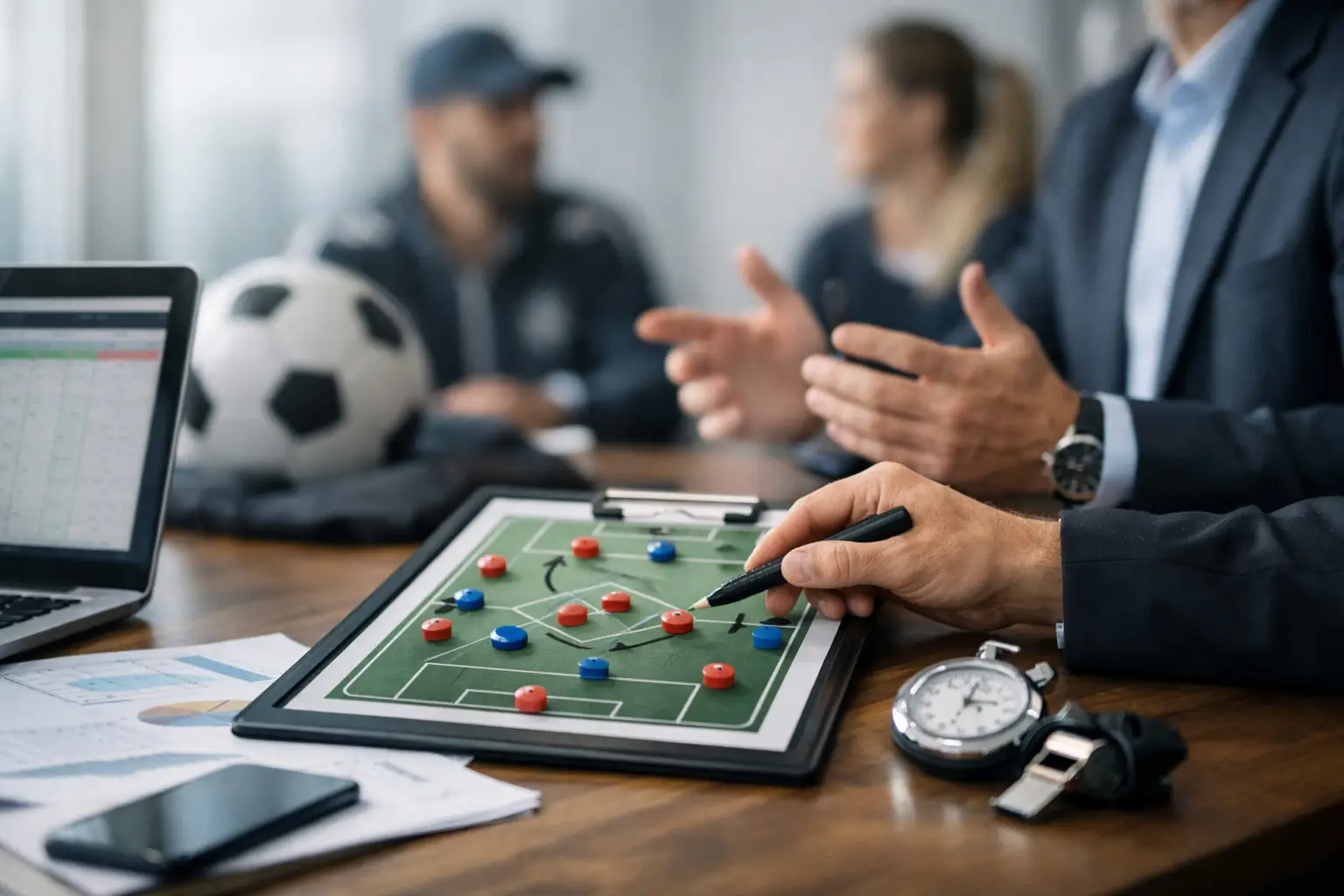
The match kicks off in two minutes. A player asks about playing time, the assistant coach wants to double-check the lineup, and you know you have to keep track of goals, cards and substitutions without losing focus on the match itself. This is exactly where best practices for match management separate the calm coaching teams from those who are constantly having to claw back control.
Good match management is not about doing more. It is about removing friction in the moment of the match. When logging events takes too long, or when information ends up scattered across loose bits of paper, it undermines decisions, communication and follow-up work. For coaches and support staff standing close to the play, the goal is simple: get an overview quickly, without being pulled away from the match.
What good match management practices actually solve
On paper, match management can look like a simple task. In practice, everything happens at once. You have to follow the run of play, handle substitutions, log key events and at the same time answer players, parents or support staff. If your system is slow, you become slow.
The biggest benefit of good routines is not just tidy data after the match. It comes during the match. When you know who has been on, how long they have played, and which events have actually happened, you make better decisions in the moment. This applies especially in children's and youth football, but also in senior teams where the demands for precision are higher.
1. Use one system throughout the whole match
The most common mistake is spreading match management across several surfaces. A bit on paper, a bit in a chat, a bit in your head. It works right up until the pace picks up.
The best practice is to use one system for everything that happens in the match. Lineup, substitutions, goals, cards and playing time should all be handled in the same place. Then you avoid moving information between notes, messages and mental to-do lists. One tap should be enough to log the most important things.
This is also what makes digital tools far more practical than general note-taking apps. A match is not an ordinary meeting. It calls for quick actions built for the sideline, not manual workarounds you have to improvise yourself.
2. Turn substitutions into a plan, not a reaction
Many teams only deal with substitutions when someone asks for a rest or when a player looks tired. That can be necessary at times, but over time it often creates uneven playing time and uncertainty about who is actually supposed to come on.
Better match management starts before kick-off. Have a clear idea for rotation, and use the match to adjust - not to reinvent everything. When you have an overview of who is on the pitch and how long they have played, substitutions become easier to carry out calmly.
For teams that prioritise even playing time, this is absolutely essential. For teams that play in a more results-driven way, it is still useful, because you can make tactical substitutions without losing track of overall workload and the flow of the match.
Best practices for match management when logging events
Events have to be logged as they happen, not five minutes later. If you wait, the details start to blur. Who got the card? When did the goal come? Was it before or after the substitution?
The best practice is simple: log in the moment with as few steps as possible. The less friction, the greater the chance the data is actually correct. This is especially important when the match is tight, or when several things happen in quick succession.
Precise logging also has value after the match. You can go back with confidence, assess development, document playing time and answer questions without guessing. It saves time and reduces unnecessary arguments.
3. Treat playing time as a live overview
Playing time is often the hardest thing to keep accurate throughout an entire match. Many coaches think they are in control right up until the match is over and someone asks why one player got 18 minutes more than another.
That is why playing time should not be treated as follow-up work. It has to be visible during the match. When you can see workload and distribution in real time, you can adjust before the imbalance grows large. It makes running the match both fairer and more predictable.
This is especially useful in grassroots football, where development and enjoyment are often closely tied to a sense of fairness. But it also gives you an edge in more competitive football. You gain better control over who has actually withstood the match workload, not just who you feel has played a lot.
4. Keep your focus on the match, not the admin
It sounds obvious, but many systems disrupt more than they help. If you have to tap through several menus to make a simple entry, the tool steals attention away from the play.
Best practices for match management therefore also mean choosing solutions built for use on the sideline. Big buttons, quick actions and a clear overview are not small details. They decide whether you actually use the system when the match is on.
There is an important difference between admin at the office and admin during a match. On the sideline you do not have time to search. You need a setup that keeps up with the pace of the match.
5. Clarify roles before the match begins
Even with a good tool, match management can fall apart if no one knows who does what. Should the head coach log everything themselves? Should the assistant manage substitutions? Who keeps an eye on cards and goals if chaos breaks out?
The most effective solution is to clarify roles in advance. One person should have main responsibility for logging, while the rest of the team knows how to support without creating duplicate work. That way you avoid important events being forgotten or logged inconsistently.
In smaller teams, one person can do everything. In larger teams, dividing roles is even more important. The point is not more tasks, but clearer responsibility.
6. Adapt the method to the match format
Admin in 5-a-side football is not the same as in 11-a-side. Pace, number of substitutions and the need for rotation all vary. That is why one rigid method does not work equally well for every match format.
In small-sided games, frequent substitutions and even playing time are often the most important thing. In 11-a-side, structure around positions, disciplinary events and the run of the match tends to become more central. The best method is the one that suits the format you are actually leading, not the one that looks most complete on paper.
A good match tool should support both without you having to rebuild your workflow for every match. This is where specialised solutions make sense. They let you work quickly, even when the match format changes.
7. Use match data for the next match, not just the archive
Match management becomes far more valuable when the information is put to use afterwards. If your entries only end up as documentation, you get just half the benefit.
Data from the match should help you with the next selection, the next rotation plan and the next assessment of workload. Who has had little playing time over the last few matches? Who has been involved in the most key events? Who needs a different role or better follow-up?
There is also an important balance here. You do not need to over-analyse every match at youth level. Too much detail can become noise. But the basic data - playing time, substitutions, goals, cards and the run of the match - gives you a far better basis for decisions than gut feeling alone.
When simplicity is the best method
Many coaches think better match management requires more advanced processes. Often it is the opposite. The best solution is usually the one you can actually manage to use consistently throughout the whole season.
If the workflow is simple enough to work in rain, noise and match stress, you are on the right track. If you have to tidy up your notes after every match, the system is too complicated. On the sideline, simplicity almost always beats features you rarely use.
That is also why a dedicated tool like MatchDay fits this situation so well. When goals, cards, substitutions and playing time can be logged with one tap on an iPhone or iPad, match management becomes a support function instead of an extra problem you have to handle.
A calmer match picture starts with better control
You notice the difference when the admin is under control. Not because the match becomes less intense, but because you avoid spending energy on remembering what should have been logged straight away. Then you get more time to watch the play, talk to the players and make better decisions while the match is alive.
That is perhaps the most practical benefit of all. Good match management does not just give you tidier follow-up work. It gives you a calmer sideline when it matters most.